

Let’s be honest.
Almost everyone wants to grow their money, but most beginners in India are confused about where to start investing.
Some people keep their savings in a bank account for years.
Some invest in FD because it feels safe.
Others want high returns but are scared of losing money.
And because of this confusion, many people never start investing at all.
They keep waiting for the “right time”.
But here’s the truth:
There is no perfect time to start investing.
The best time is when you understand where to invest and take your first step.
Today, even if you earn a normal salary, you can start investing with ₹500 or ₹1000 per month and slowly build serious wealth over time.
You don’t need to be rich.
You don’t need stock market expertise.
You just need the right guidance.
In this beginner-friendly guide, you’ll learn:
- Best investment options in India for beginners
- Safe investments with good returns
- Where you should start as a beginner
- How much money you need to start
- Mistakes to avoid while investing
If you are new to investing and want to grow your money smartly in 2026 and beyond, this guide will help you make the right decisions.
Let’s start with something very important.
The best investment options in India for beginners include mutual funds, SIP, public provident fund (PPF), fixed deposits, and index funds. Beginners should start with simple and low-risk investments and gradually move towards higher-return options for long-term wealth creation.
WHY INVESTING IS IMPORTANT IN INDIA
Many people believe saving money is enough.
But in reality, saving alone will never make you wealthy.
If you simply keep your money in a savings account, its value keeps decreasing because of inflation.
For example:
If inflation in India is around 6–7% yearly and your bank savings give only 3% interest, your money is actually losing value every year.
This means the cost of living keeps rising, but your money doesn’t grow fast enough.
This is why investing becomes important.
Investing helps your money grow faster than inflation and builds long-term wealth.
When you start investing early:
- Your money grows through compounding
- You can achieve financial freedom faster
- You can build a retirement corpus
- You don’t depend only on salary
- You can achieve big goals like house, car, travel
Even small investments done consistently for many years can turn into a big amount.
For example:
If you invest ₹5,000 per month for long term in good investments, you can build lakhs and even crores over time.
That’s the power of investing.
If you are completely new and wondering how SIP works, you can also read our detailed guide on SIP and how it helps build wealth, which explains how small monthly investments can create large wealth over time.
Now the big question comes:
Where should beginners actually invest money?
Let’s look at the best options available in India.
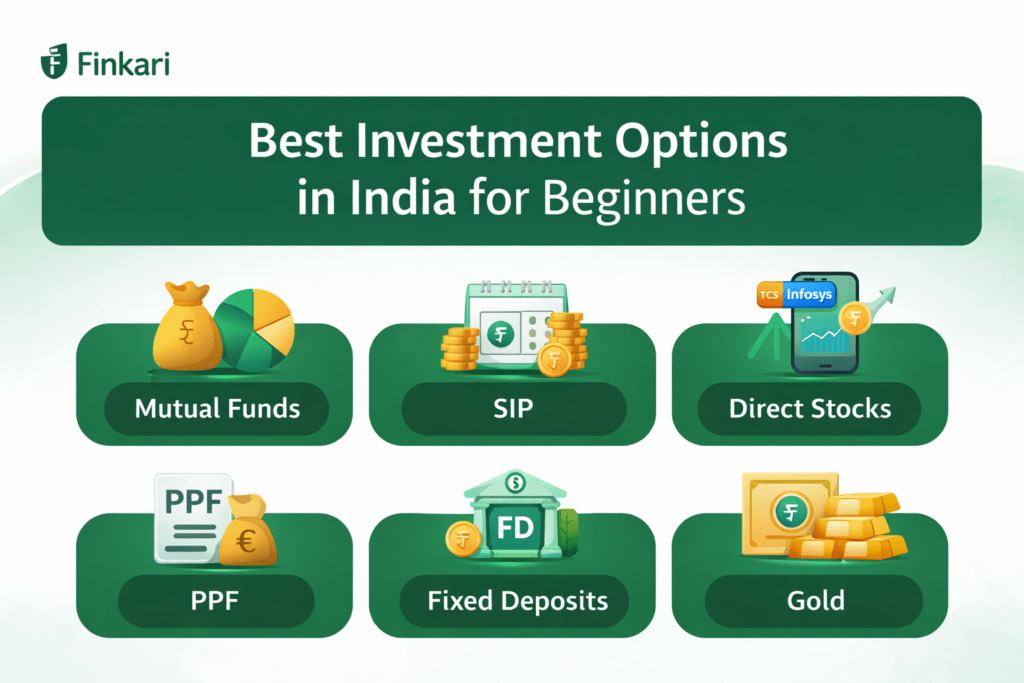
BEST INVESTMENT OPTIONS IN INDIA FOR BEGINNERS
Now comes the most important part.
If you are a beginner, you don’t need 20 different investment products.
You only need to understand a few solid options that are:
- Easy to start
- Safe (depending on type)
- Suitable for beginners
- Capable of growing your money
Let’s look at them one by one.
1. Mutual Funds (Best for Most Beginners)
If there is one investment option that suits most beginners in India, it is mutual funds.
A mutual fund collects money from many investors and invests it in stocks, bonds, or other assets. It is managed by professional fund managers.
You don’t need to select stocks yourself.
That makes it beginner friendly.
There are different types:
- Equity mutual funds (higher return, higher risk)
- Debt mutual funds (lower risk, lower return)
- Hybrid funds (mix of both)
For long-term wealth building, equity mutual funds are usually better.
Example:
If you invest ₹5,000 per month through SIP in a good equity mutual fund for 15–20 years, you can build a large corpus due to compounding.
If you are new to this concept, you can read our detailed guide on what is SIP and how it helps to build wealth, where we explain how small monthly investments grow over time.
Why mutual funds are good for beginners:
- Start with ₹500
- Professionally managed
- Diversified (reduces risk)
- Easy to invest through apps
For most beginners in 2026, mutual funds should be the starting point.
If you are confused about which funds to choose, check our detailed list of the best mutual funds for beginners in India to start your investment journey.
best mutual funds for beginners in India
2. Systematic Investment Plan (SIP)
SIP is not a separate investment product. It is a method of investing regularly in mutual funds.
Instead of investing ₹60,000 at once, you invest ₹5,000 every month.
This has two big advantages:
- Discipline
- Rupee cost averaging
When markets go down, you buy more units.
When markets go up, you buy fewer units.
Over long periods, this reduces risk.
Example:
If someone invests ₹3,000 per month for 20 years at an average return of 12%, the final amount can cross ₹25–30 lakhs.
That’s the power of consistency.
If you are wondering whether SIP can really make you wealthy, you can also check our detailed article on whether SIP can make you a crorepati.
For salaried people, SIP is one of the simplest ways to start investing.
If you are completely new and don’t understand SIP yet, read our detailed guide on what is SIP and how it helps build wealth step by step.
what is SIP and how it helps build wealth
3. Direct Stocks (For Slightly Advanced Beginners)
Stock market investing means buying shares of companies like:
- Reliance
- TCS
- HDFC Bank
- Infosys
When the company grows, your investment grows.
But here is the important truth:
Stocks can give high returns, but they also come with high risk.
Prices go up and down daily.
If you don’t understand business or panic during market fall, you can lose money.
That’s why for complete beginners:
Start with mutual funds first.
Then slowly learn stock investing.
Direct stocks are better when:
- You understand company fundamentals
- You are ready for volatility
- You are investing for long term
Stocks are powerful, but they are not the first step for everyone.
4. Public Provident Fund (PPF) – Safe Long-Term Option
If you want safety with guaranteed returns, PPF is a good option.
It is backed by the Government of India.
Features:
- 15-year lock-in
- Fixed interest (changes yearly)
- Tax benefits under Section 80C
- Very low risk
PPF is good for:
- Conservative investors
- Retirement planning
- Long-term safe savings
But returns are lower compared to equity mutual funds.
So it should not be your only investment if you want wealth creation.
5. Fixed Deposits (FD) – Low Risk, Low Growth
FD is one of the most common investments in India.
You deposit money in a bank for a fixed period and get fixed interest.
It is safe.
It is predictable.
But returns are usually low (around 6–7%).
After adjusting inflation and tax, real returns are very small.
FD is useful for:
- Emergency money
- Short-term goals
- Risk-averse investors
But if your goal is long-term wealth, FD alone is not enough.
6. Gold (Physical or Digital)
Gold has always been popular in India.
You can invest in:
- Physical gold
- Gold ETFs
- Sovereign Gold Bonds
Gold is good for diversification.
But gold does not generate income like stocks or mutual funds.
It is better used as 5–10% part of portfolio, not full investment.
Quick Summary for Beginners
If you are completely new and confused, here is simple guidance:
- For long-term wealth → Mutual funds (via SIP)
- For safety → PPF
- For short-term safety → FD
- For growth + knowledge → Stocks (after learning)
- For diversification → Gold
Now the important question:
Where should YOU start as a beginner?
Let’s answer that clearly in next section.
WHERE SHOULD BEGINNERS START INVESTING?
After seeing so many investment options, most beginners feel confused.
Mutual funds, stocks, FD, PPF, gold…
Where should you actually start?
Let’s make this very simple.
If you are a complete beginner in India, you do not need a complicated portfolio.
You only need a simple and practical starting plan.
Step 1: Build an Emergency Fund First
Before investing, make sure you have some money saved for emergencies.
Life is unpredictable.
Medical expenses, job loss, or sudden expenses can happen anytime.
You should keep at least 3–6 months of expenses in a savings account or FD.
Example:
If your monthly expenses are ₹20,000
Emergency fund = ₹60,000 to ₹1,20,000
This money is not for investing.
It is for safety.
Once this is ready, you can start investing confidently.
Step 2: Start With SIP in Mutual Funds
For most beginners, the best place to start investing is mutual funds through SIP.
Why?
Because:
- You can start with small amount
- Risk is spread across many stocks
- Managed by professionals
- Easy to automate monthly
Even ₹500 or ₹1000 per month is enough to begin.
Consistency matters more than amount.
If you invest every month for many years, compounding starts working.
For example:
A person investing ₹5,000 monthly for 20 years at average 12% return can build more than ₹45–50 lakhs.
Starting early is more important than starting big.
Step 3: Increase Investment With Salary Growth
As your salary increases, increase your investments too.
If you start with ₹3,000 per month today, try to increase SIP every year.
This habit can completely change your financial future.
Many people increase lifestyle with salary hike but forget investing.
Smart investors increase investments first.
Step 4: Slowly Learn Stock Market
Once you are comfortable with mutual funds and understand market basics, you can start learning stock investing.
You don’t need to rush.
Take time to understand:
- How companies grow
- How stock market works
- Long-term investing mindset
Then you can slowly invest small amount in stocks.
SAFE VS HIGH RETURN INVESTMENTS
Every beginner wants high returns.
But high returns always come with some risk.
Understanding this balance is very important.
Safe Investments (Low Risk)
These investments protect your money but returns are lower.
Examples:
- Fixed deposits
- PPF
- Savings account
- Government bonds
Returns: Usually 5–8% per year
Risk: Very low
Best for:
- Emergency fund
- Short-term goals
- Conservative investors
High Return Investments (Higher Risk)
These investments can grow your money faster but prices fluctuate.
Examples:
- Mutual funds (equity)
- Stocks
- ETFs
Returns: 10–15% long term (not guaranteed)
Risk: Medium to high
Best for:
- Long-term wealth creation
- Retirement planning
- Beating inflation
Smart Strategy for Beginners
Don’t choose only safe or only risky.
Use a mix.
Example beginner strategy:
- 70% in mutual funds
- 20% in safe options (PPF/FD)
- 10% in gold or others
This gives balance between growth and safety.
HOW MUCH MONEY SHOULD YOU INVEST MONTHLY?
One of the biggest myths is:
“I need a lot of money to start investing.”
That is completely false.
You can start investing with very small amounts.
If your salary is ₹20k–₹30k
Start investing: ₹1,000–₹3,000 per month
If salary is ₹40k–₹60k
Start investing: ₹5,000–₹10,000 per month
If salary is ₹80k+
Try investing: 20–30% of income
The exact amount is not important.
Consistency is important.
Even ₹2,000 monthly invested for long term is better than waiting to invest big amount later.
If you want a detailed example, you can also read our guide on how to invest ₹10,000 per month and build wealth, where we explain real long-term calculations.
SAMPLE BEGINNER INVESTMENT PORTFOLIO
If you are confused about how to divide money, here is a simple beginner portfolio.
Example: Person investing ₹10,000 per month
- ₹6,000 → Equity mutual funds (SIP)
- ₹2,000 → PPF or safe option
- ₹1,000 → Gold or ETF
- ₹1,000 → Savings/emergency
This is simple and balanced.
As income grows, you can increase SIP amount.
You don’t need a complicated strategy to build wealth.
Simple + consistent investing works best.
COMMON INVESTING MISTAKES BEGINNERS MUST AVOID
Starting your investment journey is great.
But avoiding mistakes is even more important.
Many beginners lose money or stop investing because they make simple errors in the beginning.
Let’s make sure you don’t repeat them.
1. Waiting for the “Perfect Time”
Many people keep waiting for the perfect time to invest.
They think:
“I’ll start when salary increases”
“I’ll start when market crashes”
“I’ll start next year”
But the truth is – perfect time never comes.
The earlier you start, the more you benefit from compounding.
Even small investments started today are better than big investments started later.
2. Investing Without Goal
Some people randomly invest in FD, mutual funds, or stocks without any clear goal.
Always invest with purpose.
Ask yourself:
- Is this for retirement?
- Buying a house?
- Wealth creation?
- Emergency fund?
When you invest with a goal, you stay consistent and disciplined.
3. Expecting Quick Returns
Investing is not a get-rich-quick scheme.
Stock market and mutual funds can give excellent returns, but only with patience.
Many beginners panic when market falls for few months and stop investing.
Wealth is built over years, not weeks.
If you stay invested long term, temporary market ups and downs won’t matter.
4. Investing All Money in One Place
Putting all money in one investment is risky.
Example:
- All money in FD → low growth
- All money in stocks → high risk
Smart investors diversify.
They spread money across:
- Mutual funds
- Safe options
- Gold or others
This balance protects wealth and helps growth.
5. Stopping SIP During Market Fall
This is one of the biggest mistakes.
When market falls, many people stop SIP because they get scared.
But market fall is actually the best time to continue SIP.
Why?
Because you buy more units at lower price.
When market recovers, your investment grows faster.
Long-term investors never panic during short-term market volatility.
SMART TIPS TO GROW YOUR MONEY FASTER
If you want to build serious wealth over time, follow these simple but powerful habits.
Start Early
The earlier you start, the more time compounding gets.
Example:
Person A starts investing at age 22
Person B starts at 32
Even if both invest same amount, Person A can build almost double wealth by retirement.
Time is the biggest advantage in investing.
Many investors have built huge wealth through consistent SIP investing. You can read this guide on how SIP can help you become a crorepati with disciplined investing.
become a crorepati with SIP
Increase Investment Every Year
Whenever your salary increases, increase your investment too.
Even increasing SIP by 5–10% every year can make huge difference in long term.
This is one habit that separates average earners from wealthy investors.
Stay Invested for Long Term
Real wealth is created by staying invested for many years.
Not by jumping in and out of market.
If you stay invested for:
- 1–2 years → small results
- 5 years → good growth
- 10–20 years → serious wealth
Patience is the secret.
Keep Learning About Money
Financial knowledge is powerful.
Learn basics of:
- Mutual funds
- Stock market
- Asset allocation
- Tax saving
The more you learn, the better decisions you make.
FREQUENTLY ASKED QUESTIONS
What is the best investment option for beginners in India?
For most beginners, mutual funds through SIP are one of the best options because they are easy to start, diversified, and suitable for long-term wealth creation.
Can I start investing with ₹500?
Yes. Many mutual funds allow SIP starting from ₹500 per month. Starting small is perfectly fine.
Which investment is safest in India?
PPF, fixed deposits, and government-backed schemes are considered among the safest investment options in India.
Is stock market safe for beginners?
Stock market can be volatile. Beginners should start with mutual funds and slowly learn before investing directly in stocks.
How much should I invest monthly?
A good rule is to invest at least 20% of your income if possible. But even small amounts like ₹1,000–₹3,000 per month are good to start.
FINAL CONCLUSION
Starting your investment journey may feel confusing in the beginning.
There are many options, many opinions, and a lot of noise.
But you don’t need to overcomplicate things.
If you remember just a few simple points, you’ll be ahead of most people:
Start early.
Invest regularly.
Stay consistent.
Think long term.
You don’t need lakhs to begin.
Even small monthly investments, done consistently for years, can create life-changing wealth.
The biggest mistake is not starting.
So choose a simple investment option like SIP, begin with whatever amount you can, and slowly build your financial future step by step.
Your future self will thank you for starting today.
5 thoughts on “Best Investment Options in India for Beginners (2026 Ultimate Guide)”