

Let’s be honest.
One of the biggest reasons people don’t start investing is they don’t know how much money to start investing in India.
Or
“How much money do I actually need to start investing?”
Many people believe investing requires a lot of money.
They think you need:
₹50,000
₹1 lakh
Or a very high salary
Because of this belief, they keep postponing investing for years.
Some wait for salary increase.
Some wait for savings to grow.
Some think investing is only for rich people.
But here’s the truth most people don’t realize:
You don’t need a big amount to start investing in India.
In today’s time, you can start investing with as little as ₹500 or ₹1000 per month and slowly build serious wealth over time.
What matters is not how much you start with.
What matters is how early and how consistently you invest.
Even small amounts invested regularly can grow into lakhs and even crores in the long term due to compounding.
In this detailed beginner-friendly guide, you’ll learn:
- Minimum money needed to start investing in India
- How much you should invest based on your salary
- Whether small investments really work
- Best way to start with limited money
- Smart investment plan for beginners
- Mistakes to avoid
If you’ve been waiting to start investing because you think you don’t have enough money, this guide will clear all your doubts.
Let’s start with the most important truth about investing.
What is the minimum amount needed to start investing in India?
You can start investing in India with as little as ₹500 per month through SIP in mutual funds. However, investing ₹2,000 to ₹5,000 per month is a more practical starting point for beginners who want to build meaningful long-term wealth.
YOU DON’T NEED A LOT OF MONEY TO START INVESTING
One of the biggest myths in India is that investing requires a large amount of money.
This is simply not true anymore.
Earlier, investing in stocks or mutual funds required bigger capital.
But today, technology and financial apps have made investing accessible to everyone.
You can start investing with:
- ₹500 in mutual funds (SIP)
- ₹1000 monthly investment
- Small stock investments
- Digital gold or index funds
This means even students or people with small salaries can start their investment journey.
The goal is not to start big.
The goal is to start early.
Because time in the market is more powerful than the amount invested.
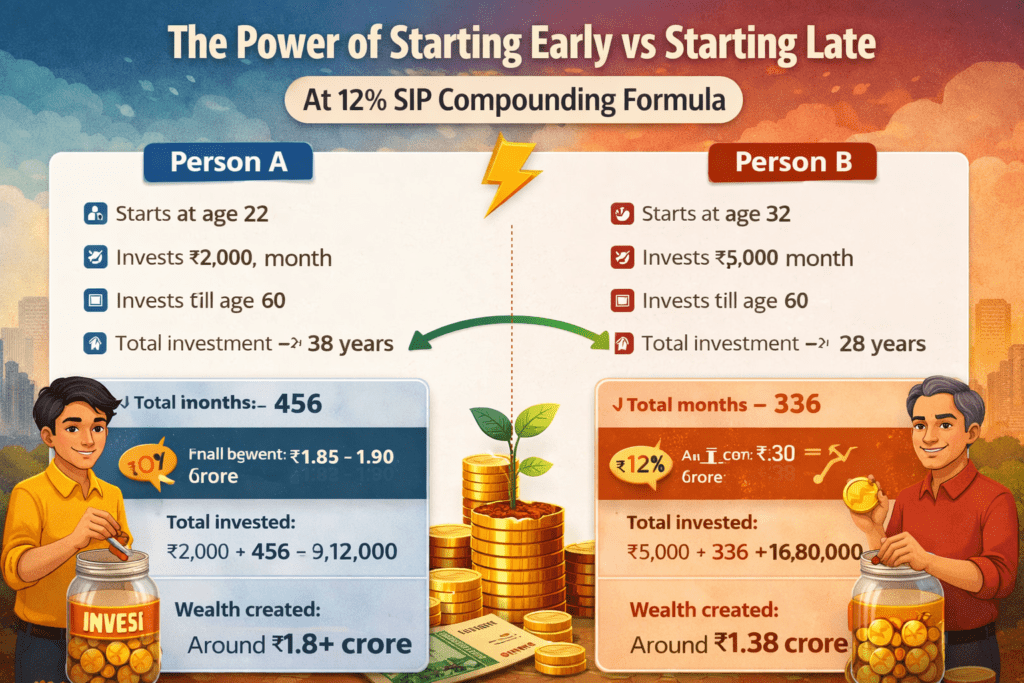
For example:
Two people start investing:
Person A starts at age 22 with ₹2,000/month
Person B starts at age 32 with ₹5,000/month
Let’s calculate properly assuming:
- 12% average annual return
- Monthly SIP
- Retirement age = 60
- Compounding monthly
Monthly return ≈ 1% (12% ÷ 12)
Person A
- Starts at age 22
- Invests ₹2,000 per month
- Invests till age 60
- Total investment period = 38 years
- Total months = 456
Using SIP compounding formula at 12%:
👉 Final amount ≈ ₹1.85 – ₹1.90 Crore
Total invested:
₹2,000 × 456 = ₹9,12,000
Wealth created:
Around ₹1.8+ crore
That’s the power of starting early.
Person B
- Starts at age 32
- Invests ₹5,000 per month
- Invests till age 60
- Total investment period = 28 years
- Total months = 336
At 12% average return:
👉 Final amount ≈ ₹1.35 – ₹1.40 Crore
Total invested:
₹5,000 × 336 = ₹16,80,000
Wealth created:
Around ₹1.38 crore
Powerful Insight
Person B invested:
₹16.8 lakh (almost double)
Person A invested:
₹9.1 lakh (almost half)
But Person A ends up with more money.
Why?
Because of 10 extra years of compounding.
Even though Person B invests more money monthly, Person A can still build more wealth because of 10 extra years of compounding.
That’s the power of starting early.
You can check you own SIP returns using our Free SIP Calculator
If you’re still confused about where beginners should invest, you can also read our detailed guide on the best investment options in India for beginners, where we explain all options step by step.
Now let’s answer the main question clearly:
How Much Money to Start Investing in India?
The simple answer is:
You can start investing with as little as ₹500 per month in India.
Yes, you read that right.
You don’t need thousands or lakhs to begin your investment journey.
Today, many mutual funds allow you to start a SIP (Systematic Investment Plan) with just ₹500 or ₹1000 per month.
This means almost anyone with a basic salary can begin investing.
But just knowing the minimum amount is not enough.
You should also understand what a good starting amount looks like based on your income and financial situation.
Let’s break it down in a practical way.
Starting With ₹500–₹1,000: Is It Worth It?
Many beginners feel that investing ₹500 or ₹1,000 won’t make any difference.
But that thinking is wrong.
Small investments may look insignificant in the beginning, but when done consistently for many years, they can grow into a meaningful amount.
For example:
If you invest ₹1,000 per month in a mutual fund for 25 years at an average return of 12%, your total investment will be ₹3 lakhs.
But the final value can grow to around ₹17–18 lakhs due to compounding.
This is why starting small is completely fine.
The goal at the beginning is not to invest a big amount.
The goal is to build the habit of investing every month.
Once the habit is built, you can always increase the amount as your salary grows.
Ideal Minimum Amount to Start Investing
Although ₹500 is enough to begin, a more practical starting range for most people is:
₹2,000 to ₹5,000 per month
This amount allows your investments to grow meaningfully over time and also builds financial discipline.
If you can comfortably invest within this range without affecting your daily expenses, it is a great place to start.
If not, even ₹500–₹1,000 is perfectly fine.
Remember:
Starting early with a small amount is far better than waiting to start big later.
Where Should Beginners Invest Small Amounts First?
If you are starting with a small amount, the best place to begin is mutual funds through SIP.
Reasons:
- Low minimum investment
- Diversified portfolio
- Managed by professionals
- Good long-term growth potential
This makes mutual funds one of the most beginner-friendly investment options in India.
If you’re still confused about where to invest as a beginner, you can also read our detailed guide on the best investment options in India for beginners, where we’ve explained each option step by step.
Important Rule: Never Invest All Your Money
Before you start investing, make sure you have some emergency savings.
A good rule is to keep at least 3–6 months of expenses in savings or a bank account before investing aggressively.
Investing without any emergency fund can force you to withdraw investments during emergencies, which breaks long-term growth.
Once your emergency fund is ready, you can start investing regularly without stress.
Next, let’s understand something even more practical:
How much should YOU invest based on your salary?
Because the right investment amount is different for someone earning ₹20,000 and someone earning ₹1 lakh per month.
How Much Should You Invest Based on Your Salary?
Now comes the most practical part.
While the minimum amount to start investing can be ₹500 or ₹1000, the real question is:
How much should you actually invest every month based on your income?
There is no single perfect number that fits everyone.
But there are smart guidelines you can follow.
A simple rule used by many financial experts is:
Try to invest at least 20% of your monthly income.
If that feels difficult initially, start with whatever you can and gradually increase over time.
Let’s look at realistic examples based on different salary levels in India.
If Your Monthly Salary is ₹20,000–₹30,000
If you are earning in this range, your main focus should be building financial discipline and starting early.
You can begin with:
- ₹1,000 to ₹3,000 per month in SIP
- Small emergency savings alongside
Example:
If someone earning ₹25,000 invests ₹2,000 per month for 25 years at 12% average return, the final value can grow to around ₹37–40 lakhs.
This shows that even small monthly investments can create significant wealth over time.
At this stage, don’t worry about investing big.
Focus on consistency.
If Your Monthly Salary is ₹40,000–₹60,000
In this salary range, you should aim to invest more seriously.
A good starting point:
- ₹5,000 to ₹10,000 per month
- Increase SIP every year with salary hike
Example:
If you invest ₹8,000 per month for 25 years at 12% return, the final value can grow to around ₹1 crore.
This is how many salaried people build wealth without doing anything extraordinary — just consistent investing.
If Your Monthly Salary is ₹80,000–₹1,00,000+
If you are earning above ₹80k or ₹1 lakh, you have a strong opportunity to build wealth faster.
You should try to invest:
- 20–30% of your income
- Increase investment every year
Example:
Investing ₹20,000 per month for 25 years at 12% average return can grow to around ₹2.5–3 crores.
This is why higher income combined with disciplined investing can create financial freedom much earlier.
A Simple Rule to Decide Your Investment Amount
If you’re still confused about how much to invest, follow this simple rule:
Start with whatever amount feels comfortable.
Then increase it slowly every year.
For example:
- Year 1 → ₹3,000/month
- Year 2 → ₹5,000/month
- Year 3 → ₹7,000/month
This gradual increase makes investing easier and sustainable.
Many people fail because they try to invest a large amount suddenly and then stop after a few months.
Consistency always beats intensity in investing.
What If You Can Only Invest ₹500 or ₹1000?
That’s completely fine.
Don’t feel discouraged if your starting amount is small.
Even ₹500 per month is enough to build the habit of investing.
Once your income increases, you can increase the amount anytime.
The biggest mistake is not starting at all.
Starting small but staying consistent is far more powerful than waiting to start big.
What Is the Best Way to Start Investing With Small Money in India?
If you are starting with a small amount like ₹500, ₹1000 or ₹3000 per month, the biggest question is:
Where should you invest first?
Because choosing the right investment in the beginning makes a huge difference in the long term.
You don’t need complicated strategies or risky investments.
You just need a simple and smart starting plan.
Let’s understand the best way to begin.
1. Start With SIP in Mutual Funds
For most beginners in India, the easiest and smartest way to start investing with small money is through SIP in mutual funds.
SIP allows you to invest a fixed amount every month automatically.
You can start with:
- ₹500
- ₹1000
- ₹2000
Why SIP is perfect for beginners:
- You don’t need large capital
- Risk is spread across multiple stocks
- Professionally managed
- Easy to start using apps
- Builds discipline
For example:
If you invest ₹3,000 monthly in a mutual fund for 20–25 years, you can build a significant amount over time due to compounding.
You don’t need to worry about market ups and downs in the short term.
Long-term consistency is what matters most.
If you want to understand this in detail, you can also read our guide on what is SIP and how it helps build wealth, where we explain everything step by step.
2. Increase Investment Slowly Every Year
When you start with a small amount, don’t keep it fixed forever.
As your salary increases, increase your investments too.
Even increasing your SIP by ₹1,000 every year can make a massive difference over time.
Example:
If someone starts with ₹3,000 monthly and increases it by 10% every year, the final wealth created after 20–25 years can be significantly higher compared to keeping the same amount constant.
This strategy is called step-up investing, and it works very well for salaried individuals.
3. Avoid Risky Investments in the Beginning
Many beginners get attracted to:
- Intraday trading
- Crypto hype
- “Double money” schemes
- Tips from friends
This is risky.
When you are starting with limited money, your first goal should be building stable long-term wealth, not taking unnecessary risks.
Focus on:
- Mutual funds
- Index funds
- Long-term investing
Once you gain experience and knowledge, you can explore other options.
4. Keep Emergency Savings Alongside
Even if you are investing small amounts, always keep some emergency savings.
A good approach:
- Save small amount in bank
- Invest small amount in SIP
This balance ensures you don’t need to stop investments during emergencies.
A Simple Beginner Investment Plan
If you are just starting out and confused, follow this simple plan:
Start with ₹2,000–₹5,000 monthly SIP
Increase investment every year
Stay invested long term
Avoid panic during market fall
This simple strategy alone can help you build serious wealth over time.
Common Mistakes Beginners Make While Starting to Invest
Starting is important.
But starting the right way is even more important.
Many beginners don’t fail because they lack money.
They fail because they make simple mistakes in the beginning.
Let’s make sure you don’t repeat them.
1. Waiting Until You Have “Enough Money”
This is the biggest mistake.
Many people think:
“I’ll start investing when I save ₹50,000.”
“I’ll start when my salary becomes ₹1 lakh.”
“I’ll start next year.”
Years pass.
Nothing changes.
The truth is simple:
You don’t need a big amount to start investing.
You just need to start.
Even ₹1,000 invested today is more powerful than ₹10,000 invested five years later.
Time matters more than amount.
2. Investing Without Emergency Fund
Some beginners invest all their savings immediately.
Then when an emergency happens, they are forced to withdraw investments.
This breaks long-term growth.
Always build:
3–6 months of expenses as emergency savings first.
After that, invest confidently.
3. Trying to Get Rich Quickly
Many beginners want fast returns.
They try:
- Intraday trading
- Random stock tips
- High-risk schemes
- Social media investment advice
This usually leads to losses.
Investing is not about getting rich in one year.
It’s about building wealth over 10, 20, or 30 years.
Slow and steady wins in investing.
4. Stopping SIP During Market Fall
This is a very common mistake.
When markets fall, many beginners panic and stop their SIP.
But market fall is actually when you are buying investments at lower prices.
Over the long term, continuing SIP during market corrections helps build more wealth.
Long-term investors stay consistent during ups and downs.
5. Not Increasing Investment Over Time
Some people start with ₹2,000 per month and keep it same for 20 years.
But salary increases every year.
Lifestyle increases every year.
Investment should also increase every year.
Even increasing SIP by 5–10% annually can significantly increase final wealth.
Quick Recap
If you remember only three things from this guide, remember this:
You don’t need a lot of money to start investing.
Start early.
Stay consistent.
Everything else becomes easier with time.
Frequently Asked Questions (FAQ)
What is the minimum amount to start investing in India?
You can start investing with as little as ₹500 per month in mutual funds through SIP. However, investing ₹2,000–₹5,000 monthly is more practical for meaningful long-term growth.
Can I start investing with ₹1,000 per month?
Yes. Many mutual funds allow SIP starting at ₹500 or ₹1,000. Small amounts invested consistently can grow significantly over time.
How much should I invest from my salary?
A good rule is to invest at least 20% of your monthly income. If that’s not possible, start with a smaller percentage and gradually increase it every year.
Is it worth investing small amounts?
Yes. Small investments become powerful when combined with time and compounding. Starting early is more important than starting big.
Final Thoughts
If you’ve been delaying investing because you think you don’t have enough money, this is your sign to start.
You don’t need lakhs.
You don’t need a high salary.
You don’t need to be an expert.
You just need to begin.
Start with ₹500, ₹1,000 or ₹2,000 — whatever you can comfortably invest.
Increase it slowly.
Stay invested for the long term.
Let compounding do its magic.
Years later, you’ll realize that the best decision you made was not waiting.
Start small.
Start today.