

If you are wondering how to invest in mutual funds, it is one of the easiest and most popular ways for beginners in India to start building wealth.
Unlike investing directly in stocks, mutual funds allow investors to pool their money together and invest in a diversified portfolio of securities such as stocks, bonds, and other financial instruments. These investments are professionally managed by experienced fund managers, making mutual funds suitable even for people who are new to investing.
Over the past decade, mutual funds have become increasingly popular in India because they provide several advantages including diversification, professional management, and the ability to start investing with small amounts.
Many investors begin their journey through Systematic Investment Plans (SIP), which allow them to invest a fixed amount every month. SIP investing helps maintain financial discipline while reducing the risk of investing large sums at the wrong time.
For beginners who want to start their investment journey but are unsure where to begin, mutual funds offer a simple and accessible solution.
In this guide, we will explain:
- What mutual funds are and how they work
- The different types of mutual funds available in India
- The step-by-step process to start investing
- How to choose the right mutual funds
- Common mistakes beginners should avoid
By the end of this article, you will clearly understand how to invest in mutual funds and start your investing journey confidently.
Quick Answer: How to Invest in Mutual Funds
Investing in mutual funds in India is a simple process that beginners can start in just a few steps.
The basic steps to invest in mutual funds are:
- Complete your KYC verification using PAN and Aadhaar.
- Choose the type of mutual fund that matches your investment goals.
- Decide whether to invest through SIP (monthly investment) or lump sum investment.
- Select an investment platform such as AMC website, mutual fund apps, or investment platforms.
- Start investing regularly and stay invested for the long term.
Following these steps allows beginners to start investing in mutual funds with small amounts and gradually build wealth over time.
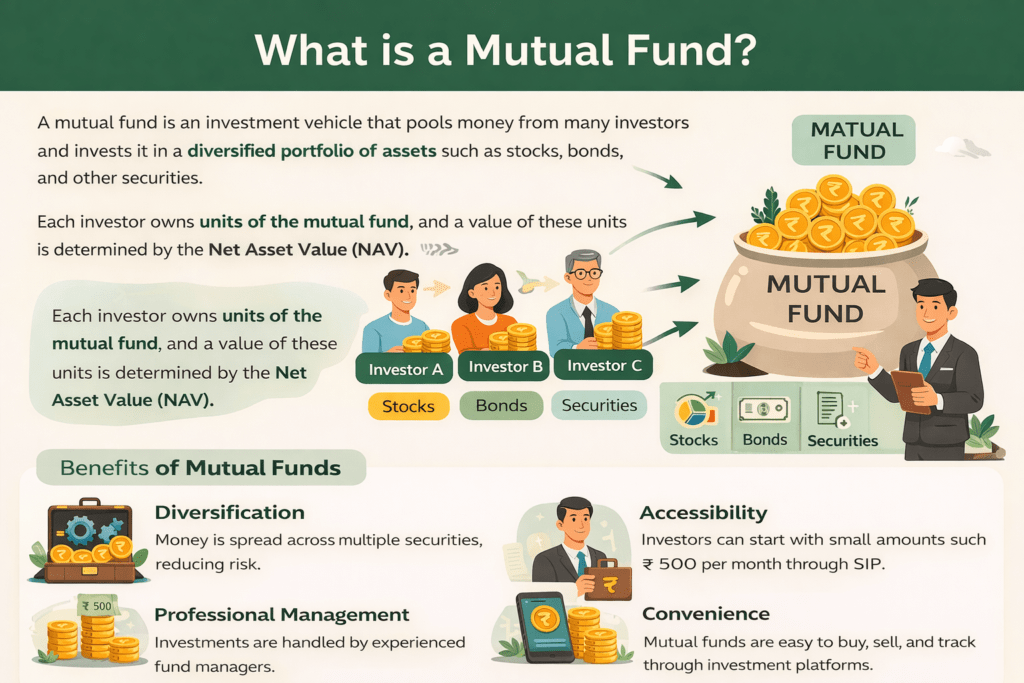
What is a Mutual Fund?
A mutual fund is an investment vehicle that pools money from many investors and invests it in a diversified portfolio of assets such as stocks, bonds, and other securities.
Instead of selecting individual stocks or bonds themselves, investors place their money in a mutual fund, and a professional fund manager manages the investment on their behalf.
The fund manager decides which securities to buy or sell based on the fund’s objective. For example, some mutual funds focus on equity (stocks) for long-term growth, while others invest in debt instruments for stability and lower risk.
Each investor owns units of the mutual fund, and the value of these units is determined by the Net Asset Value (NAV). The NAV changes daily based on the performance of the assets held in the fund.
Mutual funds are popular among beginners because they offer several benefits:
- Diversification: Money is spread across multiple securities, reducing risk.
- Professional management: Investments are handled by experienced fund managers.
- Accessibility: Investors can start with small amounts such as ₹500 per month through SIP.
- Convenience: Mutual funds are easy to buy, sell, and track through investment platforms.
Because of these advantages, mutual funds have become one of the most widely used investment options for individuals who want to build long-term wealth without actively managing their investments.
How Mutual Funds Work
To understand how mutual funds work, imagine a group of investors pooling their money together to invest in the financial markets.
The pooled money is managed by a fund manager, who invests it in different assets such as stocks, bonds, or other securities based on the fund’s objective.
Each investor receives units of the mutual fund based on the amount invested. The value of these units is determined by the Net Asset Value (NAV) of the fund.
The NAV represents the per-unit value of the fund and changes daily depending on the market value of the assets held by the fund.
Example of How Mutual Fund Investment Works
| Investor | Amount Invested | NAV | Units Received |
|---|---|---|---|
| Investor A | ₹10,000 | ₹20 | 500 Units |
| Investor B | ₹20,000 | ₹20 | 1000 Units |
| Investor C | ₹30,000 | ₹20 | 1500 Units |
In this example, investors pool their money into a mutual fund, and the fund manager invests the total amount across different assets.
If the value of the underlying investments increases, the NAV rises, and investors benefit from capital appreciation. Over time, this growth can help investors build wealth through long-term investing.
Active vs Passive Mutual Funds
Mutual funds can broadly be classified into active funds and passive funds depending on how the portfolio is managed.
Understanding the difference between these two types helps investors choose the right investment strategy based on their goals and risk tolerance.
Active Mutual Funds
Active mutual funds are managed by professional fund managers who actively select stocks or bonds in an attempt to outperform the market.
The fund manager analyzes companies, studies market trends, and decides which securities to buy or sell to generate higher returns than the benchmark index.
For example, an actively managed equity mutual fund may try to outperform the Nifty 50 or Sensex index by selecting stocks that the fund manager believes will perform better than the market.
Active funds usually have higher expense ratios because they involve research, portfolio management, and active trading.
Active mutual funds may be suitable for investors who:
- want professional management
- aim to beat market returns
- are comfortable with slightly higher costs
Passive Mutual Funds
Passive mutual funds aim to replicate the performance of a market index rather than outperform it.
These funds simply invest in the same stocks and in the same proportion as the index they track.
For example, a Nifty 50 Index Fund invests in the same 50 companies that make up the Nifty 50 index.
Because passive funds do not require active stock selection or research, they generally have lower expense ratios compared to actively managed funds.
Passive investing has become increasingly popular because it provides:
- lower investment costs
- transparent portfolio structure
- market-linked returns
Active vs Passive Mutual Funds Comparison
| Feature | Active Mutual Funds | Passive Mutual Funds |
|---|---|---|
| Management Style | Actively managed by fund managers | Tracks a market index |
| Objective | Beat the market index | Match market returns |
| Expense Ratio | Higher | Lower |
| Risk Level | Depends on fund manager decisions | Market risk |
For many beginners, index funds (a type of passive mutual fund) are often considered a good starting point because they are simple, transparent, and cost-efficient.
However, both active and passive funds can play a role in a well-diversified investment portfolio.
Types of Mutual Funds in India
Mutual funds in India are classified based on the type of assets they invest in and the investment objective of the fund. Understanding these categories helps investors choose the right mutual funds based on their risk tolerance, financial goals, and investment horizon.
The four most common types of mutual funds are equity funds, debt funds, hybrid funds, and index funds.
| Mutual Fund Type | Where It Invests | Risk Level | Best For |
|---|---|---|---|
| Equity Funds | Stocks of companies | High | Long-term wealth creation |
| Debt Funds | Government bonds and fixed income securities | Low to Moderate | Short-term stability |
| Hybrid Funds | Mix of equity and debt | Moderate | Balanced risk and return |
| Index Funds | Replicates market index such as Nifty 50 | Market Risk | Low-cost passive investing |
Equity Mutual Funds
Equity mutual funds invest primarily in the stocks of publicly listed companies. These funds aim to generate higher returns over the long term but can experience short-term market volatility.
Equity funds are generally suitable for investors with an investment horizon of five years or more.
Debt Mutual Funds
Debt mutual funds invest in fixed income securities such as government bonds, treasury bills, and corporate bonds.
These funds are typically considered less risky than equity funds and are suitable for investors looking for stability or short-term investment options.
Hybrid Mutual Funds
Hybrid mutual funds invest in a combination of equity and debt instruments. The goal is to balance risk and returns by combining the growth potential of equities with the stability of fixed-income investments.
These funds can be suitable for investors who want moderate risk exposure.
Index Funds
Index funds are a type of passive mutual fund that aim to replicate the performance of a market index such as the Nifty 50 or Sensex.
Because these funds simply track an index instead of actively selecting stocks, they typically have lower expense ratios and are considered a simple option for beginners.
In addition to understanding different types of mutual funds, beginners should also learn how to actually start investing in them step by step.
In the next section, we will explain the complete process of investing in mutual funds in India, including KYC, choosing funds, and starting your first investment.
How to Invest in Mutual Funds (Step-by-Step Guide)
Starting a mutual fund investment in India is a simple process. Today, most investors can complete the entire process online using investment platforms or mutual fund apps.
Below are the basic steps beginners should follow to start investing in mutual funds.
Step 1: Complete Your KYC
Before investing in mutual funds, you must complete Know Your Customer (KYC) verification.
KYC helps verify your identity and ensures compliance with financial regulations.
Typically, the following documents are required:
- PAN Card
- Aadhaar Card
- Bank Account Details
- Mobile Number and Email ID
KYC can be completed online through mutual fund platforms, investment apps, or AMC websites.
Step 2: Decide Your Investment Goal
Before selecting a mutual fund, it is important to define why you are investing.
Different financial goals require different types of mutual funds.
Examples of investment goals include:
- Building long-term wealth
- Saving for retirement
- Buying a house
- Funding children’s education
Your investment horizon and risk tolerance will determine the most suitable mutual fund category.
Step 3: Choose the Right Type of Mutual Fund
Once your goal is clear, you can select the appropriate type of mutual fund.
| Investment Goal | Suggested Mutual Fund Type |
|---|---|
| Short-term goals (1–3 years) | Debt funds |
| Medium-term goals (3–5 years) | Hybrid funds |
| Long-term goals (5+ years) | Equity mutual funds |
This approach ensures that your investment strategy matches your financial goals.
Step 4: Choose Between SIP or Lump Sum Investment
Mutual funds can be invested in two main ways.
SIP (Systematic Investment Plan) allows investors to invest a fixed amount every month. This method helps build discipline and reduces the risk of market timing.
Lump Sum Investment involves investing a large amount at once. This approach may work better when markets are undervalued or when investors have a large amount available to invest.
Many beginners prefer SIP because it allows them to start investing with small monthly contributions.
You can also learn more about the difference in our guide on SIP vs Lump Sum Investment – Which is Better?
Step 5: Choose an Investment Platform
Mutual funds can be purchased through multiple platforms in India.
Common options include:
- Asset Management Company (AMC) websites
- Mutual fund investment apps
- Online investment platforms
- Stock brokers
Most platforms allow investors to invest in direct mutual funds, which typically have lower expense ratios compared to regular plans.
Step 6: Start Investing and Stay Consistent
Once you select the mutual fund and investment method, you can begin investing.
Many investors start with small monthly investments and gradually increase their contributions as their income grows.
Consistency and long-term investing are key to benefiting from compounding and market growth.
How Much Money Should Beginners Invest in Mutual Funds?
One of the most common questions beginners ask is how much money they need to start investing in mutual funds.
The good news is that mutual funds are accessible even for small investors. Many mutual funds in India allow investors to start with as little as ₹500 per month through a Systematic Investment Plan (SIP).
The amount you invest should depend on your income, financial goals, and monthly expenses. Instead of trying to invest a large amount immediately, it is usually better to start with a manageable monthly investment and gradually increase it over time.
Financial planners often recommend investing 20–30% of your income toward savings and investments if possible.
Below is a simple example of how beginners can structure their investments based on salary.
| Monthly Salary | Suggested Monthly SIP | Investment Strategy |
|---|---|---|
| ₹25,000 | ₹2,000 – ₹3,000 | Start with index or hybrid funds |
| ₹50,000 | ₹5,000 – ₹8,000 | Diversify between index and flexi-cap funds |
| ₹75,000 | ₹10,000 – ₹15,000 | Add mid-cap or hybrid funds |
| ₹1,00,000+ | ₹20,000+ | Build diversified long-term portfolio |
Starting small is perfectly fine. The key is to remain consistent and allow your investments to grow over time through the power of compounding.
Example: How Mutual Fund SIP Can Grow Over Time
To understand the power of long-term investing, consider a simple example.
Suppose an investor starts a SIP of ₹10,000 per month in an equity mutual fund and earns an average annual return of 12%.
| Investment Period | Total Amount Invested | Approx Value at 12% |
|---|---|---|
| 10 Years | ₹12,00,000 | ₹23,00,000+ |
| 20 Years | ₹24,00,000 | ₹99,00,000+ |
| 30 Years | ₹36,00,000 | ₹3.5 Crore+ |
This example shows how consistent investing and long-term compounding can significantly grow your wealth over time.
Even small monthly investments can eventually grow into a large corpus when invested for long periods.
3 Important Things to Check Before Selecting a Mutual Fund
Selecting the right mutual fund is an important step in building a successful investment portfolio. While there are thousands of mutual funds available in India, beginners can simplify the selection process by focusing on a few key factors.
Three important things investors should evaluate before choosing a mutual fund are downside protection, return consistency, and the experience of the fund manager.
1. Downside Protection
Downside protection refers to how well a mutual fund performs during market downturns.
Equity markets can be volatile, and a good mutual fund should be able to limit losses during market corrections compared to its benchmark or peer funds.
Funds that fall less during market crashes often recover faster when the market improves. This characteristic helps protect investor capital and improves long-term performance.
When analyzing downside protection, investors can compare how the fund performed during past market corrections.
2. Return Consistency
Many investors make the mistake of choosing mutual funds based only on recent high returns.
However, short-term performance can sometimes be misleading.
Instead, investors should look for funds that have delivered consistent performance over multiple years and across different market cycles.
A mutual fund that performs steadily over 5–10 years is usually considered more reliable than a fund that shows strong performance only for one or two years.
Consistency often indicates a disciplined investment strategy.
3. Fund Manager Experience
The fund manager plays a crucial role in the performance of actively managed mutual funds.
An experienced fund manager with a strong track record is more likely to make better investment decisions during both rising and falling markets.
Investors should consider factors such as:
- Years of experience managing funds
- Past performance of funds managed by the manager
- Investment strategy and approach
A capable fund manager can significantly influence the long-term success of a mutual fund.
Mutual Funds vs ETFs: How They Differ
Mutual funds and Exchange Traded Funds (ETFs) are both popular investment vehicles that allow investors to gain exposure to a diversified portfolio of assets. While they share some similarities, there are important differences in how they are structured, traded, and managed.
Understanding these differences can help investors decide which option is better suited for their investment strategy.
| Feature | Mutual Funds | ETFs (Exchange Traded Funds) |
|---|---|---|
| Trading Method | Bought and sold through mutual fund platforms | Traded on stock exchanges like shares |
| Pricing | Price based on daily NAV | Price fluctuates throughout the trading day |
| Management | Can be actively or passively managed | Usually passive index tracking |
| Minimum Investment | Can start with SIP (₹500 or ₹1,000) | Requires buying ETF units through stock exchange |
| Expense Ratio | Generally higher for active funds | Usually lower because they track indexes |
For many beginners, mutual funds are often easier to start with because they offer Systematic Investment Plans (SIP) and do not require a trading account.
ETFs, on the other hand, behave like stocks and require investors to buy and sell units on stock exchanges.
Both mutual funds and ETFs can be useful investment options depending on an investor’s financial goals, investment horizon, and preferred investment strategy.
Common Mistakes to Avoid When Investing in Mutual Funds
While mutual funds are considered beginner-friendly investment options, many investors make mistakes that can negatively affect their long-term returns. Being aware of these mistakes can help investors make more informed decisions and build a stronger investment portfolio.
1. Chasing Past Performance
Many beginners choose mutual funds based only on recent high returns. However, past performance does not guarantee future results.
Instead of focusing only on short-term returns, investors should evaluate funds that demonstrate consistent long-term performance across multiple market cycles.
2. Stopping SIP During Market Corrections
Market fluctuations are a natural part of investing.
Some investors stop their SIP investments when markets fall. However, continuing SIP during market corrections allows investors to buy more units at lower prices and benefit from rupee cost averaging.
3. Investing Without a Clear Financial Goal
Investing without defined financial goals can lead to poor financial planning.
Before selecting mutual funds, investors should identify clear objectives such as:
- retirement planning
- children’s education
- buying a house
- long-term wealth creation
Aligning investments with financial goals helps create a more structured investment strategy.
4. Choosing Too Many Mutual Funds
Some investors believe that holding many mutual funds improves diversification.
In reality, owning too many funds can create unnecessary overlap and make portfolio management difficult.
For most beginners, a simple portfolio of two to four well-chosen mutual funds is usually sufficient to achieve diversification and long-term growth.
Example Mutual Fund Portfolio for Beginners
One of the most common questions beginners ask is how many mutual funds they should include in their portfolio.
For most new investors, it is better to keep the portfolio simple. Instead of investing in too many funds, a portfolio of two to three well-diversified mutual funds is usually enough to achieve diversification.
A simple beginner portfolio can include:
- a large-cap index fund for stability
- a flexi-cap fund for diversified exposure
- a mid-cap fund for higher growth potential
This combination helps balance stability and long-term growth.
Below is a simple example of a beginner mutual fund portfolio.
| Fund Category | Purpose | Suggested Allocation |
|---|---|---|
| Nifty 50 Index Fund | Exposure to large stable companies | 50% |
| Flexi Cap Fund | Diversified across large, mid, and small companies | 30% |
| Mid Cap Fund | Higher growth potential over long term | 20% |
This type of portfolio allows investors to participate in different segments of the market while maintaining diversification.
For example, if a beginner wants to invest ₹10,000 per month through SIP, the allocation could look like this.
| Monthly Investment | Fund Type |
|---|---|
| ₹5,000 | Nifty 50 Index Fund |
| ₹3,000 | Flexi Cap Fund |
| ₹2,000 | Mid Cap Fund |
This simple allocation keeps the investment strategy easy to follow while still maintaining diversification.
Frequently Asked Questions (FAQs)
How do beginners invest in mutual funds?
Beginners can start investing in mutual funds by completing their KYC verification, selecting a suitable mutual fund based on their financial goals, and choosing an investment method such as SIP or lump sum.
Most new investors prefer Systematic Investment Plans (SIP) because they allow small monthly investments and help build wealth gradually through compounding.
What if I invest ₹10,000 in mutual funds every month?
If you invest ₹10,000 per month through a SIP and earn an average return of around 12% annually, your investment can grow significantly over time.
For example, a ₹10,000 monthly SIP for 20 years could grow to approximately ₹1 crore, depending on market performance.
What are the main types of mutual funds?
The main types of mutual funds include:
- Equity Mutual Funds – Invest mainly in stocks and are suitable for long-term growth.
- Debt Mutual Funds – Invest in fixed-income securities and are generally less volatile.
- Hybrid Mutual Funds – Invest in both equity and debt instruments.
- Index Funds – Passive funds that track market indices like the Nifty 50 or Sensex.
Each category serves different investment goals and risk profiles.
Is mutual fund investment safe?
Mutual funds are regulated by the Securities and Exchange Board of India (SEBI), which ensures transparency and investor protection.
However, mutual funds are market-linked investments, which means their value can rise or fall depending on market conditions. Long-term investing helps reduce the impact of short-term volatility.
How much money should beginners invest in mutual funds?
Beginners can start investing in mutual funds with as little as ₹500 per month through SIP.
The ideal investment amount depends on income, expenses, and financial goals. Many financial experts suggest investing 20–30% of your monthly income toward savings and investments.
When is the best time to invest in mutual funds?
The best time to invest in mutual funds is as early as possible.
Trying to time the market is difficult, so many investors use SIP investing, which spreads investments over time and reduces the risk of investing at the wrong market level.
Conclusion
Mutual funds have become one of the most popular investment options for beginners in India because they offer diversification, professional management, and the ability to start investing with small amounts.
Instead of trying to select individual stocks, investors can use mutual funds to gain exposure to a diversified portfolio managed by experienced fund managers.
For beginners who are wondering how to invest in mutual funds, the process is simple. It involves completing KYC, selecting the right type of mutual fund based on financial goals, and investing consistently through SIP or lump sum investments.
Starting early and staying invested for the long term allows investors to benefit from the power of compounding, which can significantly grow wealth over time.
The most important step is to begin investing with a clear financial plan and remain disciplined throughout the investment journey.
Disclaimer
The information provided in this article is for educational and informational purposes only and should not be considered financial or investment advice. Mutual fund investments are subject to market risks, and past performance does not guarantee future results.
Before making any investment decisions, investors should carefully evaluate their financial goals, risk tolerance, and investment horizon. It is recommended to read all scheme-related documents carefully and consult a qualified financial advisor if necessary.
Finkari does not promote or recommend any specific mutual fund schemes. The examples used in this article are for illustrative purposes only and should not be interpreted as investment recommendations.